
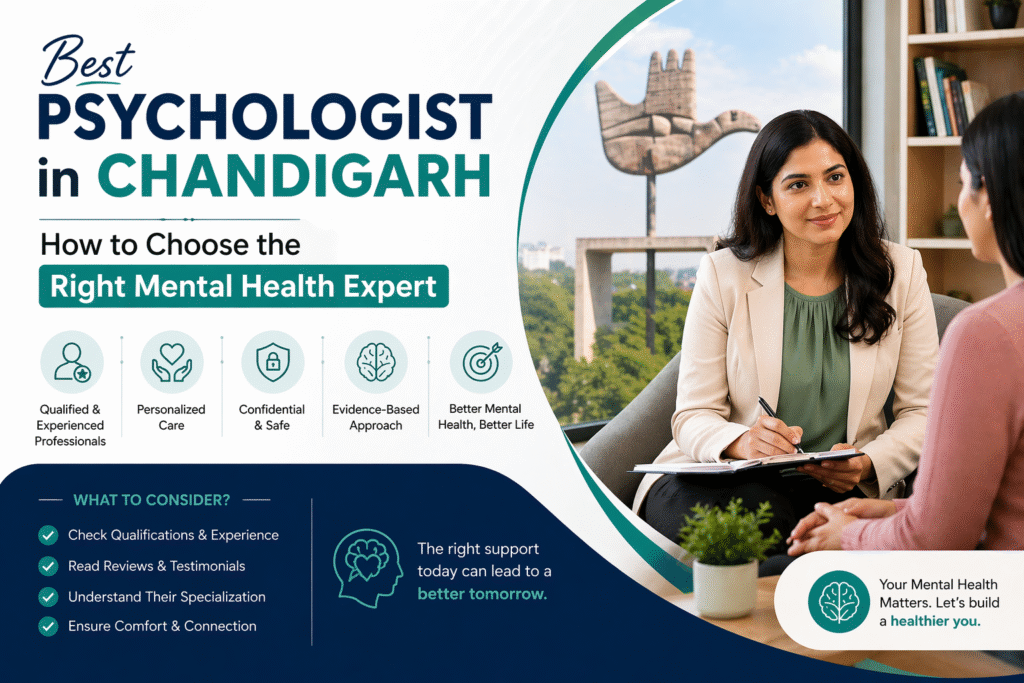
Best Psychologist in Chandigarh: How to Choose the Right Mental Health Expert
There’s a particular kind of silence I’ve noticed in my practice.
It shows up in people who look like they’re doing everything right—stable careers, well-settled families, lives that appear… sorted. And yet, when they sit across from me, there’s a pause before they begin. Almost as if they’re not used to saying things out loud.
In cities like Chandigarh, life is often designed to look orderly. Sector by sector, everything in place. But emotional lives don’t follow that kind of structure.
So when someone finally decides to seek therapy, the question they usually arrive with is:
“How do I find the best psychologist?”
And I often find myself gently reframing that.
Because the real question is:
“Who is the right psychologist for me?”
It’s Not About “Best.” It’s About Fit.
I’ll say something that might sound counterintuitive—there is no universally best psychologist.
There are highly qualified, deeply experienced professionals, yes. But therapy is less like choosing a top-rated restaurant and more like finding someone you can sit with in your most unfiltered moments.
I remember a client—let’s call her Riya. On paper, she had already tried “the best.” Big names, impressive clinics. But she said something very simple in our first session:
“I always felt like I had to say the right things.”
That sentence stayed with me.
Because therapy doesn’t work when you’re performing.
Start With What You’re Carrying
Before you look outward, it helps to look inward.
Not in an overwhelming way, just gently asking:
What feels most difficult right now?
Is it anxiety that doesn’t switch off?
Is it a relationship that feels heavy, even when nothing is “wrong”?
Is it a vague sense of being stuck?
You don’t need perfect clarity. Most people don’t have it.
But even a rough sense of what you’re dealing with helps you find someone who works in that space. Some psychologists are more structured and solution-focused. Others go deeper into patterns, relationships, and emotional history.
Neither is better. Just… different.
The Chandigarh Context (It Matters More Than We Admit)
Therapy doesn’t happen in a vacuum.
In North India, and particularly around Chandigarh, people don’t come in as individuals alone. They come with families, expectations, unspoken rules.
I often see this tension:
“I want to make my own choices… but I don’t want to disappoint my parents.”
Or:
“Everything is fine at home, so why do I feel this way?”
There’s a certain emotional restraint many of us have grown up with. We’ve learned to manage, adjust, move on. Therapy, for some, feels unfamiliar because it asks you to pause instead.
So when you’re choosing a psychologist, it helps if they understand this context—not just clinically, but culturally. Otherwise, you may find yourself explaining your world before you can even begin to explore it.
The First Session Will Tell You More Than Any Profile
People often spend a lot of time researching—degrees, certifications, years of experience.
All of that matters. Of course it does.
But what matters just as much is this:
How do you feel in the room?
Do you feel rushed?
Do you feel like you’re being analyzed… or understood?
There’s no dramatic moment where you suddenly feel “healed.” It’s subtler.
Sometimes it’s just:
“Okay… I can say this here.”
I’ve had clients who spoke very little in the first session. Long pauses. Half-finished sentences. And yet, at the end, they’d say, “I think I can come back.”
That’s a good sign.
A Small but Important Warning: Be Careful of Quick Fixes
This is something I feel quite strongly about.
If therapy is being presented as something that will “fix” you in 2–3 sessions, it’s worth pausing.
Not because change isn’t possible quickly—but because most emotional patterns have history. And history doesn’t unravel on a deadline.
I once worked with a client who had been told repeatedly to “just think positive.” By the time she came in, she wasn’t just anxious—she was also frustrated with herself for not being able to “snap out of it.”
We spent weeks just understanding what her anxiety was doing for her before we even began to change it.
That’s the work.
Online or In-Person? It’s Not a Right/Wrong Decision
Post-COVID, a lot of therapy has moved online—and surprisingly, many people prefer it.
There’s comfort in being in your own space. No travel, no waiting rooms.
But then there are others who need the physical separation—a place that is not home, not work, just… neutral.
I usually tell people:
Choose the format where you’re more likely to be honest.
That matters more than anything else.
Practical Things (Less Glamorous, But Very Real)
This part often gets overlooked, but it can quietly determine whether therapy actually continues.
Are the session timings workable for you?
Is the fee something you can sustain over time?
Is it easy enough to access, especially on difficult days?
Because therapy isn’t about one powerful session. It’s about showing up, again and again, even when you don’t feel like it.
What Good Therapy Should Do (Eventually)
Not immediately. But over time.
You should start to notice small shifts:
You catch your thoughts before they spiral
You understand your reactions a little better
You pause where earlier you would react
And perhaps most importantly—you begin to feel less alone in your own mind.
Good therapy doesn’t make you dependent on the therapist.
It helps you become more… anchored within yourself.
So, How Do You Choose the Right Psychologist in Chandigarh?
Maybe not by asking:
“Who is the most popular?”
But by asking:
Can I be real with this person?
Do they understand the world I come from?
Do I feel just a little less guarded here?
And if the answer is “I’m not sure yet”—that’s okay too.
Sometimes, finding the right therapist takes a couple of tries. That’s not a setback. It’s part of the process.
A Closing Thought
Reaching out for therapy still isn’t easy for many people here.
There’s hesitation. Sometimes even guilt.
But if there’s one thing I’ve learned over the years, it’s this:
People don’t come to therapy because they are weak.
They come because, at some point, they’re ready to stop carrying everything alone.
And that’s not a small decision.
It’s a very human one.